

Lighting Guide
Don't let the technical jargon dim your shine. Here is everything you need to know to choose the perfect light for your space.
CRI (Color Rendering Index)
What it is: Think of CRI as "High Definition" for your eyes. It measures how accurately a light shows colors compared to natural sunlight.
The Breakdown:
- CRI 80: Good standard. Fine for hallways or storage.
- CRI 90+: Excellent. Must-have for living rooms, kitchens, and retail. Makes food look tasty and clothes look real.
Color Temperature (CT)
What it is: This determines the "mood" of the room. It’s measured in Kelvin (K).
The Breakdown:
- 3000K (Warm White): cozy, relaxing, like sunset. Perfect for bedrooms and living rooms.
- 4000K (Natural White): Clean, neutral, alert. Great for kitchens, bathrooms, and offices.
- 6000K (Cool White): Bright, clinical, daylight. Used in hospitals or garages.
Warm
Natural
Cool
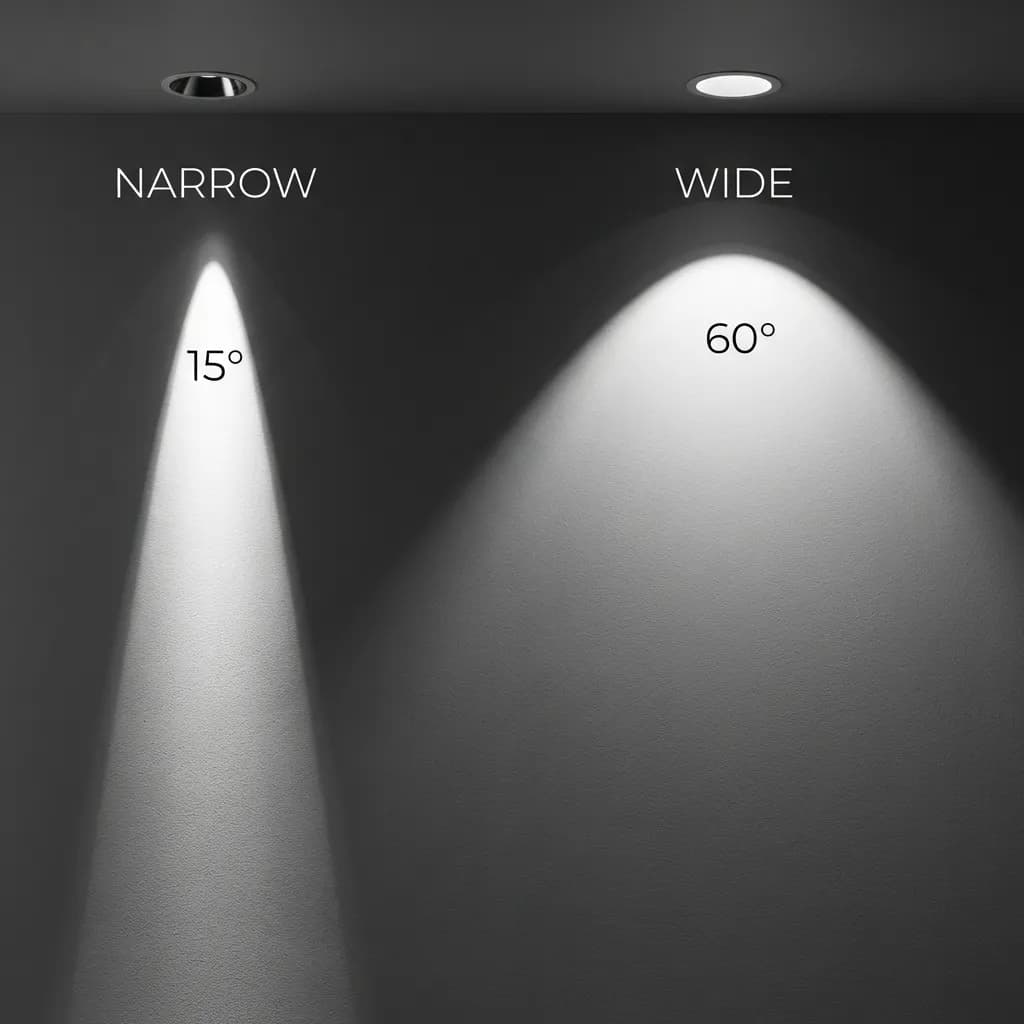
Beam Angle
What it is: The spread of light. Do you want a spotlight or a floodlight?
Highlighting art, columns, or specific objects. Cinematic and dramatic.
The standard. Good for general lighting over kitchen islands or dining tables.
General illumination. Fills a room with soft light. Best for offices or large living areas.
IP Rating (Ingress Protection)
What it is: How tough is your light against dust and water?
IP20
Indoor Only. No water protection. Perfect for bedrooms & living rooms.
IP44
Splash Proof. Good for bathroom vanity areas (zone 2).
IP54
Dust & Splash Protected. Great for covered balconies.
IP65
Waterproof. Can handle rain and jets of water. Essential for gardens and showers.
Watts vs. Lumens
The Confusion: We used to buy bulbs by Watts (Energy). Now we buy by Lumens (Brightness).
Rule of Thumb:
Check the Lumens.- 400-500 Lumens: Bedside lamp
- 800-1000 Lumens: Standard room light (like an old 60W bulb)
- 1500+ Lumens: Bright workspace
Watts now just tells you how much electricity you are paying for. Lower Watts + High Lumens = Money Saved.
Voltage (V)
What it is: Example: The "pressure" in the pipe.
Mains Voltage (AC 220V-240V)
Standard household power in many regions. Most spotlights and ceiling lights connect directly to this.
Low Voltage (DC 12V / 24V)
Safe to touch. Typically used for LED Strips or Magnetic Track Systems. Requires a Driver/Transformer.
Warning: Never connect a 12V/24V product directly to 220V mains power. It will blow the fuse immediately.